PRESENTATION ARCHIVE

OVERVIEW

Gateway communities are the small towns outside of national parks, forests, scenic rivers, and ski resorts. This presentation will highlight the housing, transportation, and development challenges that these communities faced in the aftermath of the COVID 19 pandemic. Our study...

Read more

PRESENTATION ARCHIVE

OVERVIEW

With findings from a mixed methods research study, this interdisciplinary webinar will present results from a historical public document analysis, a GIS spatial analyses, client surveys and interviews, and interviews with professionals and service providers. In 2019, the delivery of homeless sheltering services in Salt Lake County transitioned from a centralized emergency shelter to a scattered site model with multiple resource center locations, operated by multiple service providers. To understand the degree to which “proximity” to public transportation and other needed services was achieved, this study examined:

  1. how the decentralization of homeless services influenced transportation demand and mobility patterns for persons experiencing homelessness; and
  2. how transportation and mobility changes affected access to services.

Findings reveal that while the region’s homelessness services system changed, the...

Read more
Webinar: Modeling Freeway Traffic in a Mixed Environment: Connected and Human-Driven Vehicles - Terry Yang


PRESENTATION ARCHIVE

Miss the webinar or want a look back?

OVERVIEW

Although connected vehicles (CVs) will soon go beyond testbeds, CVs and human-driven vehicles (HVs) will co-exist over a long period. Hence, it is critical to consider the interactions between these two types of vehicles in traffic flow modeling. In this study, we aim to develop a macroscopic model to understand how CVs would impact HVs in the traffic stream. Grounded on the second-order traffic flow model, we study the relationships among flow, density, and speed by two sets of formulations for the groups of CVs and HVs, respectively. A set of friction factors, which indicate CVs' impact to HVs, are introduced to the speed equation for accounting CV speed impacts. Then extended Kalman Filter is employed to update both model parameters and friction factors in real-time. By using CVs trajectory data as measurements, the difference between CV average speed and overall traffic mean speed will be fully accounted. The proposed model will serve as a basis for designing CV-based traffic control function,...

Read more

PRESENTATION ARCHIVE

OVERVIEW

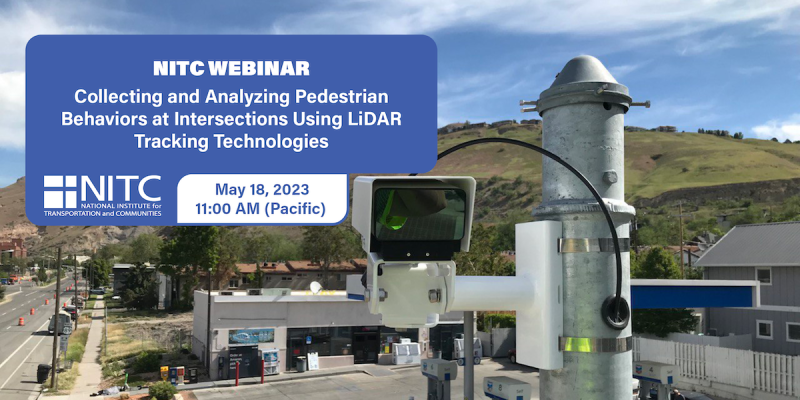
The aim of this research is to investigate pedestrian behavior at signalized intersections using state-of-the-art LIDAR sensing technologies and to use this data, along with vehicular data, to develop a more effective multimodal signal control system.

In the presentation, the presenters will describe a novel method of collecting pedestrian crossing behaviors at signalized intersection, discuss the findings and implications of data analytics, and introduce a novel approach to dynamic flashing yellow arrow mechanisms to reduce the conflict between left turn vehicles and crossing pedestrians.

KEY LEARNING OUTCOMES

  • Understand the framework of LiDAR sensing solutions;
  • Understand how to collect pedestrian behaviors at intersections;
  • Understand how to provide new protection for crossing pedestrians with object-tracking technologies.

THE RESEARCH

This webinar is based on a study funded by the National Institute...

Read more
New Travel Demand Models

PRESENTATION ARCHIVE

OVERVIEW

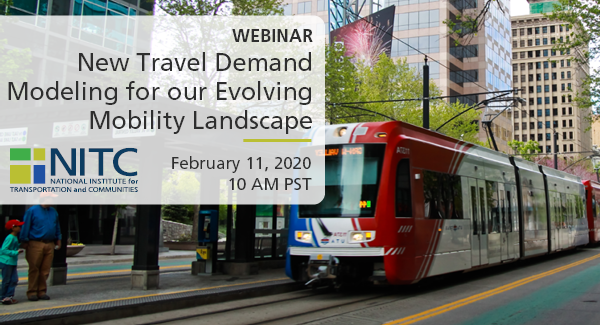
Conventional four-step travel demand models are used by nearly all metropolitan planning organizations (MPOs), state departments of transportation, and local planning agencies, as the basis for long-range transportation planning in the United States. A flaw of the four-step model is its relative insensitivity to the so-called D variables. The D variables are characteristics of the built environment that are known to affect travel behavior. The Ds are development density, land use diversity, street network design, destination accessibility, and distance to transit. In this seminar, we will explain how we developed a vehicle ownership model (car shedding model), an intrazonal travel model (internal capture model), and mode choice model that consider all of the D variables based on household travel surveys and built environmental data for 32, 31, and 29 regions, respectively, validates the models, and demonstrates that the models have far better predictive accuracy than Wasatch Front Regional Council (WFRC)/Mountailand Association of Governments’ (MAG) current models.

In this webinar, researchers Reid Ewing and Sadegh Sabouri will...

Read more

PRESENTATION ARCHIVE

OVERVIEW

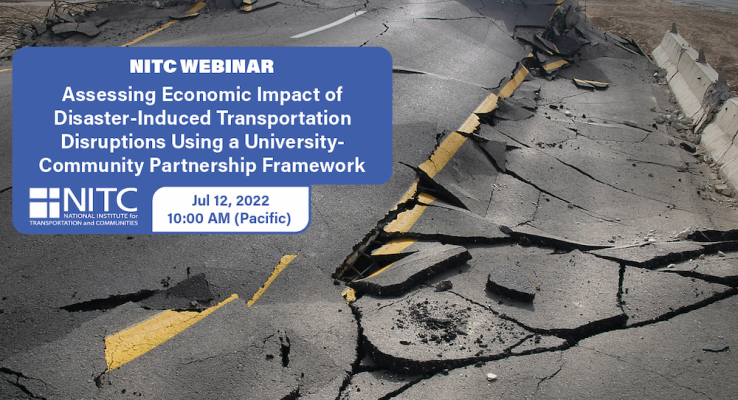
Transportation systems play a critical role in maintaining supply chains for effective post-disaster recovery. Modeling the potential economic impact of transportation-related disruptions, therefore, is an important step to promoting pre-event communitywide recovery and resilience planning. But existing supply chain and economic impact models are cost prohibitive and overly sophisticated for use by public sector entities with limited resources. There is also limited understanding of how small and medium enterprises (SMEs) adjust to post-disaster transportation disruption and how this experience influences their future preparedness for similar events. Since SMEs make up a majority of businesses within the US, post-disaster transportation loss can significantly affect the local economy and the recovery trajectory for the entire community.

This project has two objectives:

  1. To develop a collaborative university-community partnership framework for analyzing the economic impact due to transportation disruptions in earthquake country
  2. To examine SME preparedness to such managing such disruptions...
Read more
 

PRESENTATION ARCHIVE

OVERVIEW

This presentation introduces an innovative spatiotemporal analytical framework and web-based visualization platform developed by researchers at the University of Utah to assist transit agencies in identifying optimal deployment strategies for a battery-electric bus (BEB) system by using a combination of mathematical programming methods, GIS-based analysis, and multi-objective optimization techniques. The framework allows transit agencies to optimally phase in BEB infrastructure and deploy the BEB system in a way that can minimize the capital and operational cost of the BEB system while maximizing its environmental benefits (i.e., emission reduction).

KEY LEARNING OUTCOMES

  • Introduction to a bi-objective spatiotemporal optimization model for the strategic deployment of BEBs to minimize the cost of purchasing BEBs, on-route and in-depot charging stations, and to maximize environmental equity for disadvantaged populations.
  • The optimization considers the unique constraints imposed by BEB...
Read more

PRESENTATION ARCHIVE

OVERVIEW

Older adults often face challenges with mobility and accessibility, which can limit their independence and quality of life. This seminar will explore these issues and lessons learned from the research to improve travel experiences and satisfaction for older adults.

KEY LEARNING OUTCOMES

  • Highlights the importance of considering diverse dimensions of older adults' needs.
  • Found a significant dissatisfaction and vulnerability experienced by older adults with limited mobility.
  • Identified the need for addressing the critical accessibility and mobility gaps with older adults.

THE RESEARCH

This webinar is based on a study funded by the National Institute for Transportation and Communites (NITC) and conducted at the University of Utah. Read more about the project: Transportation for Seniors (T4S): Developing a New Accessibility Measure to Support Older Adults in a Post-Pandemic World.

SPEAKERS

Andy Hong, University of Utah...

Read more

Pages