
Watch video

Watch video
View slides
As metropolitan area governments and others promote density-promoting “smart growth” policies, finer analysis is needed to quantify the impact of such policies on households' transportation and housing costs. Existing research suggests that households in urban areas trade-off between housing costs and transportation costs, but does not explore how policies to increase urban densities might explicitly impact this balance. Furthermore, the research does not adequately distinguish between the effect of urban area density and the effects of other factors associated with urban area density (e.g metropolitan area size and household incomes) on housing costs. This research uses the 2000 Census Public Use Micro Sample (PUMS) person and household data from 23 of the nation's most densely populated states to identify the impact of increased population density on three housing cost measures: household rents, housing unit values, and monthly mortgage payments. Log linear models were estimated for each housing cost measure using least-squares regression. Dependent variables included household, housing unit, and geographic area characteristics, including population density. The models were found to be very similar to one another in terms of the statistical significance...
Read moreView slides
Watch video:
Transportation costs are typically a household’s second largest expense after housing. Low income households are especially burdened by transportation costs, with low income households spending up to two times as much of their income on transportation than higher income households (Litman, 2013).
Thus, access to...
Read more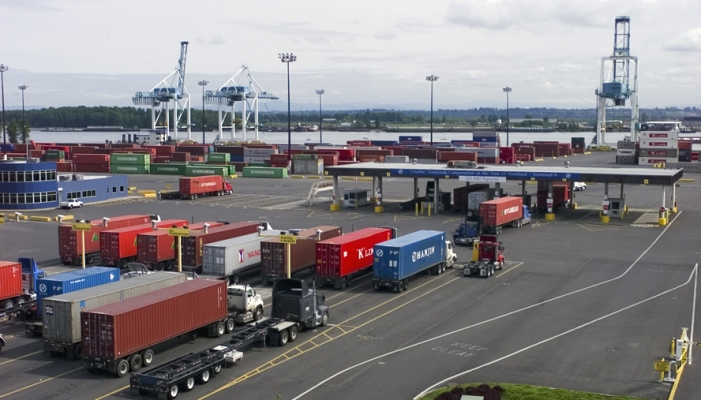
View slides
Watch video:
Although it is widely claimed that Oregon's economy is dependent on freight movement, economic activity in Oregon has decoupled from physical goods movement. Truck traffic per unit of gross state product has fallen, and even the loss of regular container service to Portland has had no measurable effect on the region's economy.
Oregon's economy has shifted away from freight intensive industries and now depends on knowledge...
Read more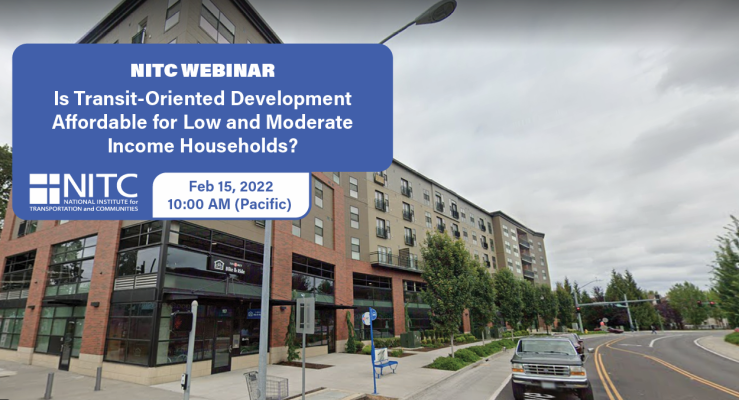
PRESENTATION ARCHIVE
OVERVIEW
Transportation and land use planning, as a field, is shifting away from segregated uses connected by highways and streets to more compact, mixed-use developments connected by high-quality transit. This new paradigm has brought special attention to transit-oriented developments (TOD), which are sometimes touted as being among the most affordable, efficient places to live. But how affordable are they, and who has the power to effect change? This study examines housing costs for households living in TODs.
KEY LEARNING OUTCOMES
- Learn how many TODs there are currently in the U.S. and what methodology was used to identify them.
- Learn what share of housing in TODs is affordable, what are the relative shares of designated versus naturally occurring affordable units and whether the level of affordability is the same for families of different sizes.
- Learn ...
View slides
Watch video:
The City of Portland is exploring how distributed “Internet of Things” (IoT) sensor systems can be used to improve the available data that is usable by city engineers, planners, and the public to help inform transportation operations, enable assessments of public health and equity, advance Portland’s Climate Action Plan goals, and...
Read morePages
- « first
- ‹ previous
- 1
- 2
- 3
- 4