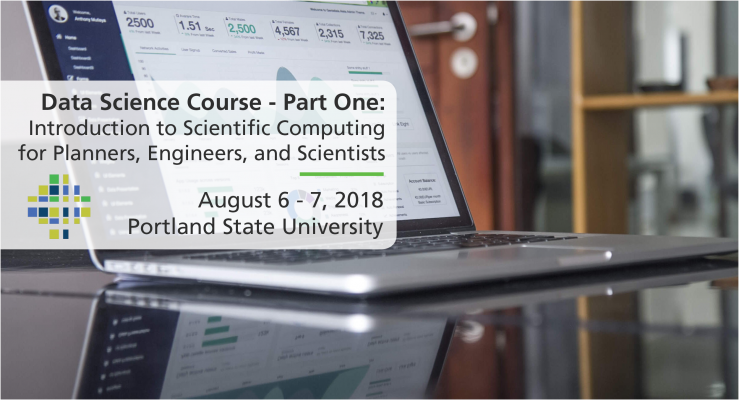
Data Science Course, Part 1: Introduction to Scientific Computing for Planners, Engineers, and Scientists with Tammy Lee and Joe Broach

For the third year, we're hosting our two-part data science course in Portland, OR. You can register for one part or the other– or attend both at a discount: Data Science Course - Part 2: Intermediate Scientific Computing for Planners, Engineers, and Scientists

Did you ever feel you are “drinking from a hose” with the amount of data you are attempting to analyze? Have you been frustrated with the tedious steps in your data processing and analysis process and thinking, “There’s gotta be a better way to do things”? Are you curious what the buzz of data science is about? If any of your answers are yes, then this course is for you.

Classes will all be hands-on sessions with lecture, discussions and labs. Participants can choose to sign up for one or both courses. For more information, download the syllabus (PDF)This course was developed as part of a NITC education project: Introduction to Scientific Computing for Planners, Engineers, and Scientists.

Agenda: Part One -...

Read more

The video begins at 1:19.

View slides

Summary: Where and when does overcrowding happen on TriMet's bus network? Which routes have the best on-time performance? Portland State University and TriMet have collaborated to make this kind of data available to anybody through Portal, PSU's transportation data archive for the Portland/Vancouver region. This presentation will cover the use of General Transit Feed Specification (GTFS) data for mapping TriMet’s performance data and the development of Portal’s innovative transit application. In the MAP-21 era of performance management, see how tools like Portal can support enhanced agency decision-making as well as community engagement.

Bio: Jon Makler researches and teaches about transportation planning and engineering at Portland State University. His research portfolio centers on intelligent transportation systems, including how they can be harnessed to benefit the environment and how the data they generate can support operational strategies and planning decisions. Since moving to Oregon 9 years ago, he has worked at Metro, the City of Portland and OTREC, the federally-funded research center housed at PSU. His previous employers were the North Jersey Transportation Planning Authority, the Harvard Kennedy School, IBI Group and Sarah...

Read more

The video begins at 2:21.

Abstract:

Adaptive signal systems have been deployed in a number of locations across the country though their high maintenance requirements and additional cost have limited their widespread use. Adaptive systems adjust phases and timings at a network of signals in real time to improve traffic operations, particularly along congested corridors.

Rhythm Engineering has developed a new video detection-based system that vastly reduces the cost of deployment and maintenance. However, no existing microsimulation software could model the system due to its innovative methodology.

The methodology involves doing away completely with concept of cycle lengths, splits, and offsets, key parameters use in traffic signal analysis today. HDR and Rhythm Engineering joined together to develop a tool to act as middleware between the adaptive system and VISSIM that would emulate video detection, send the "video" to the adaptive controller, run the adaptive controller algorithm, and transmit detector calls back to VISSIM for inclusion in the model.

This presentation will discuss the lessons learned in the development of the emulation of video detection within VISSIM as well as showing the improvements in traffic operations provided by the system. It will also discuss the implications of the system's architecture and the impact it will have on not only adaptive signal systems...

Read more

View slides

Watch video:

Smart Cities: Improving the Roadside Environment with Distributed Sensor Systems

The City of Portland is exploring how distributed “Internet of Things” (IoT) sensor systems can be used to improve the available data that is usable by city engineers, planners, and the public to help inform transportation operations, enable assessments of public health and equity, advance Portland’s Climate Action Plan goals, and...

Read more
Data Science Course - Part 2: Intermediate Scientific Computing for Planners, Engineers, and Scientists with Tammy Lee and Joe Broach

For the third year, we're hosting our two-part data science course in Portland, OR. You can register for one part or the other– or attend both at a discount: Data Science Course, Part 1: Introduction to Scientific Computing for Planners, Engineers, and Scientists

Did you ever feel you are “drinking from a hose” with the amount of data you are attempting to analyze? Have you been frustrated with the tedious steps in your data processing and analysis process and thinking, “There’s gotta be a better way to do things”? Are you curious what the buzz of data science is about? If any of your answers are yes, then this course is for you.

Classes will all be hands-on sessions with lecture, discussions and labs. Participants can choose to sign up for one or both courses. For more information, download the syllabus (PDF). This course was developed as part of a NITC education project: Introduction to Scientific Computing for Planners, Engineers, and Scientists.

Agenda: Part Two - Intermediate Course

  1. Transforming, visualizing, and modeling data
  2. ...
Read more

The video begins at 3:12.

View slides

Summary: Real-world traffic trends observed in PORTAL and INRIX traffic data are used to expand the performance measures that can be obtained from Portland Metro's travel demand model to include the number of hours of congestion that can be expected during a typical weekday and travel time reliability measures for congested freeway corridors.

Bio: Michael Mauch, a senior data analyst and project manager with DKS Associates, has over 20 years of experience in transportation data analysis, applications programming, mathematical model building and transportation demand forecasting.  Over the years, Mike has been project manager and has led the technical analyses for numerous large transportation data collection and data analysis projects including BRT and rail transit studies, CIP updates, transportation corridor studies, trip and parking generation studies, corridor capacity analysis, General and Master Plan Updates, incident management cost effectiveness analysis and numerous EIRs. In addition to working with DKS, Mike currently holds a variable-time position as a Research Engineer with UC Berkeley’s Institute of Transportation Studies.  He has taught “Traffic Flow Theory”, “Transit Operations”, and “Computer Programming & Numerical...

Read more

View slides

The video begins at 2:53.

Abstract: The concept of accessibility has long been theorized as a principal determinant of household residential choice behavior. Research on this influence is extensive but the empirical results have been mixed, with some research suggesting that accessibility is becoming a relatively insignificant influence on housing choices. Further, the measurement of accessibility must contend with complications arising from the increasing prevalence of trip-chains, non-work activities, and multi-worker households, as well as reconcile person-specific travel needs with household residential decisions. This paper contributes to the literature by addressing the gap framed by these issues and presents a novel residential choice model with three main elements of innovation. First, it operationalized a time-space prism (TSP) accessibility measure, which the authors believe to be the first application of its kind in a residential choice model. Second, it represented the choice sets in a building-level framework, the lowest level of spatial disaggregation available for modeling residential choices. Third, it explicitly examined the influence of non-work accessibility at both the local- and person-level. This residential choice model was applied in the...

Read more
Webinar: Modeling Freeway Traffic in a Mixed Environment: Connected and Human-Driven Vehicles - Terry Yang


PRESENTATION ARCHIVE

Miss the webinar or want a look back?

OVERVIEW

Although connected vehicles (CVs) will soon go beyond testbeds, CVs and human-driven vehicles (HVs) will co-exist over a long period. Hence, it is critical to consider the interactions between these two types of vehicles in traffic flow modeling. In this study, we aim to develop a macroscopic model to understand how CVs would impact HVs in the traffic stream. Grounded on the second-order traffic flow model, we study the relationships among flow, density, and speed by two sets of formulations for the groups of CVs and HVs, respectively. A set of friction factors, which indicate CVs' impact to HVs, are introduced to the speed equation for accounting CV speed impacts. Then extended Kalman Filter is employed to update both model parameters and friction factors in real-time. By using CVs trajectory data as measurements, the difference between CV average speed and overall traffic mean speed will be fully accounted. The proposed model will serve as a basis for designing CV-based traffic control function,...

Read more

Pages