The video begins at 9:25.

This paper, co-authored with Ian W.H. Parry, derives formulas for the welfare effects of reforming subsidies for peak and off-peak urban rail and bus fares, and applies them to the metropolitan areas of Washington, D.C., Los Angeles, and London. The model accounts for congestion, pollution, oil dependence, and accident externalities associated with automobiles and each transit mode. It also accounts for scale economies in transit supply, costs of accessing and waiting for transit service, crowding costs, pre-existing fuel taxes, and the transit agency’s adjustment of frequency, vehicle size, and route network in response to changes in demand. We find that in almost all cases existing subsidies – which typically exceed 50% of operating costs – are either about right, or possibly too low, across bus and rail, peak and off-peak period, in the three cities.

Speaker Biography: Kenneth A. Small, Professor Emeritus of Economics at the University of California at Irvine, specializes in urban, transportation, and environmental economics. Recent research has concentrated on urban highway congestion, measurement of value of time and reliability, effects of fuel efficiency standards, public transit pricing, and the role of fuel taxes in managing external costs of automobiles. Prof. Small served five years as coeditor of the international journal, Urban Studies, and is now Associate...

Read more

View slides

Watch video:

Integrative Public Transport in a Segmented City: Reflections from Jerusalem

Jerusalem is perhaps an extreme case of residential and travel market segmentation. It is comprised of four different 'cities', which partially overlap in space: The Jewish-Zionist city; the Palestinian city; the Jewish ultra-orthodox city and the global-tourist city. While the specific delineation of these cities is unique, Jerusalem can be seen as representative...

Read more
Friday Transportation Seminar at Portland State University - June 1, 2018

Friday Transportation Seminars at Portland State University have been a tradition since 2000. With over 450 seminars presented and recorded (access the archive of seminars here), we host both visiting and local scholars to share the latest in research, technology, and implementation in transportation.

EDUCATION LIBRARY ARCHIVE

Missed the seminar or want a look back? 


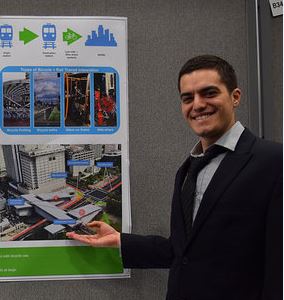
David Soto Padín
Graduate Research Assistant at Portland State University, and President of the Students in Transportation Engineering & Planning (ITE-STEP

David...

Read more

The video begins at 1:19.

View slides

Summary: Where and when does overcrowding happen on TriMet's bus network? Which routes have the best on-time performance? Portland State University and TriMet have collaborated to make this kind of data available to anybody through Portal, PSU's transportation data archive for the Portland/Vancouver region. This presentation will cover the use of General Transit Feed Specification (GTFS) data for mapping TriMet’s performance data and the development of Portal’s innovative transit application. In the MAP-21 era of performance management, see how tools like Portal can support enhanced agency decision-making as well as community engagement.

Bio: Jon Makler researches and teaches about transportation planning and engineering at Portland State University. His research portfolio centers on intelligent transportation systems, including how they can be harnessed to benefit the environment and how the data they generate can support operational strategies and planning decisions. Since moving to Oregon 9 years ago, he has worked at Metro, the City of Portland and OTREC, the federally-funded research center housed at PSU. His previous employers were the North Jersey Transportation Planning Authority, the Harvard Kennedy School, IBI Group and Sarah...

Read more

The video begins at 1:26.

Abstract: How do commuter rail riders choose access modes? This presentation discusses the results of an analysis of access mode choice by riders of one of the first U.S. suburb-to-suburb commuter railroads, the Westside Express Service (WES) in the Portland, Oregon metropolitan area. The study uses on-board survey data collected by the region’s transit agency, Tri-Met, during WES’s first year of operation. The data include observed access mode choices, historical mode usage, and subjective assessment of WES attributes. A hierarchical choice model was estimated, using attributes of the access trip and station areas as well as rider characteristics. The estimation results showed evidence of pre-WES mode inertia effects in choosing drive access, pro-sustainability attitudes in choosing bike access, the importance of comfort for light rail and auto access modes, as well as strong positive station-area effects of connecting bus lines and parking space provision. The hierarchical choice model revealed significant substitution effects between drive and light rail modes and between bike and walk modes. This study provides potentially valuable insights to agencies for the purposes of station-area planning and targeted marketing efforts.

View slides

Watch video:

Can Location Value Capture Pay for Transit?

Successful public transit systems increase the value of locations they serve. Capturing this location value to help fund transit is often sensible, but challenging.

This presentation will define location value capture, and synthesize lessons learned from six European and North American transit agencies that have experience with location value capture funding.

The opportunities for and barriers to implementing location value capture fall into three categories:

  • agency...
Read more

Pages