View slides
Watch video:
Changing weather patterns and increases in extreme weather events has led to the deployment of more weather responsive traffic management strategies. As the transportation system moves towards a connected vehicle environment, questions arise as to how connected vehicle technology can support weather responsive systems. The presentation will discuss the use of connected vehicles in a rural environment as providers of mobile weather data. Two projects will be...
Read morePRESENTATION ARCHIVE
Miss the webinar or want a look back?
OVERVIEW
Although connected vehicles (CVs) will soon go beyond testbeds, CVs and human-driven vehicles (HVs) will co-exist over a long period. Hence, it is critical to consider the interactions between these two types of vehicles in traffic flow modeling. In this study, we aim to develop a macroscopic model to understand how CVs would impact HVs in the traffic stream. Grounded on the second-order traffic flow model, we study the relationships among flow, density, and speed by two sets of formulations for the groups of CVs and HVs, respectively. A set of friction factors, which indicate CVs' impact to HVs, are introduced to the speed equation for accounting CV speed impacts. Then extended Kalman Filter is employed to update both model parameters and friction factors in real-time. By using CVs trajectory data as measurements, the difference between CV average speed and overall traffic mean speed will be fully accounted. The proposed model will serve as a basis for designing CV-based traffic control function,...
Read morePRESENTATION ARCHIVE
Miss the webinar or want a look back?
OVERVIEW
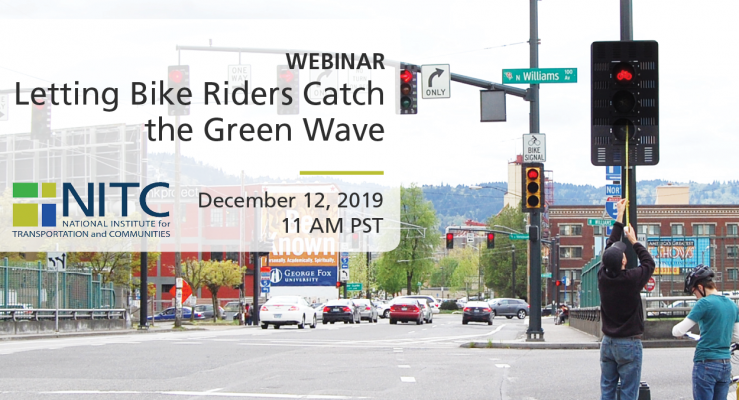
The "Fast Track" project at the University of Oregon focuses on a mode of transportation that is sometimes left out of vehicle-to-infrastructure, or V2I, conversations: Bicycling. NITC researchers developed an app based on a new technology being integrated into modern cars: GLOSA, or Green Light Optimized Speed Advisory. GLOSA allows motorists to set their speed along corridors to maximize their chances of catching a "green wave" so they won't have to stop at red lights.
This project demonstrates how GLOSA can be used by bicyclists in the same way it is used by motorists, with a test site on a busy car and bike corridor feeding the University of Oregon campus: 13th Avenue in Eugene, Oregon. Researchers developed a smartphone app that tells a cyclist whether they should adjust their speed to stay in tune with the signals and catch the next green. The project demonstrates how university researchers, city traffic engineers, and signal-controller manufacturers can come together to help bicyclists be active participants in a smart transportation...
Read more